
What premium should look and feel like can often vary due to individual perceptions, although there are notable differences in packaging formats or immersive experiences that make the little voice in our head go… 'oooh now that's a bit fancy, isn't it!'
It might be the thick textured paper stock with the bronze hot-foiled typography, or the ultra-smooth momentum scrolling whilst swiping through the spring look-book of your favorite fashion brand.
Premium, as we know it, often signals through perfection. And in design that's sometimes the result of some mind-riddled designer at 4am tweaking the Bézier curve on their brand mark, or splitting millimetres to scale their subheadings to the Fibonacci sequence for their latest publication. It can take a lot of time and energy to reach a premium aesthetic but, the point I'm getting at is that a genuine exchange for time and effort is what, for us, usually creates value, and high-valued things are often seen as premium.
In my last post I wrote about trends, and through history, the perception of premium has fluctuated, but also becomes cyclical to some degree; we don't just see this in design trends, we also see it in fashion, music and interior design. An abundance of ornament struck in the 1900s, then many years later we began to see the early signs of minimalism through the birth of Bauhaus, De Stijl, Soviet Constructivism and earlier Swiss modernism, which helped us shape modern graphic design as we know it today. As people increasingly began to associate minimalism with sophistication, a second wave of minimalism saw a vast amount of brands simplify their branding. By the time we reached the 2010s, nearly every brand with the slightest association wanted to look like Apple.
Brands continued to simplify their image until everything in the tech industry kind of looked the same. It was coined 'blanding', as Fast Company calls it in their article. However, it all persists to be firmly embedded into our daily lives. We have to ask ourselves, whilst we reach a stage where clean typography and immaculate results are so easily achieved:
Is it time for a different approach? Will AI be the final nail in the coffin for minimal blanding? I mean, you could argue that if AI could kill minimalism, it can kill all design, as the most detailed work can be generated just as fast, but it requires more human input or refined prompting to succeed with the results. But maybe this means the role of the designer needs to expand beyond simply designing the object itself.
"If I put this candle in an all-white gallery space it looks like a piece of art. If I put this candle in a garage it looks like a piece of trash. I can either spend my time designing the candle or I can spend my time designing the room that it sits in." The late Virgil Abloh
For me, this really says a lot about premium brands and how we perceive them. The environment in which we receive the product is designed to leave a longer-lasting impression and memorable experience than those who simply haven't considered it. The free taster of crumbly cheese you sampled at some whimsical farmers market, served by a pretty girl with pigtails, may taste much better than the same one your best mate pulled out of the fridge whilst he was trying to get to the beers. There might be another layer to what Virgil was trying to say, and it's not just about designing the premium products, it's allocating them with the right cultures and worlds associated with them.
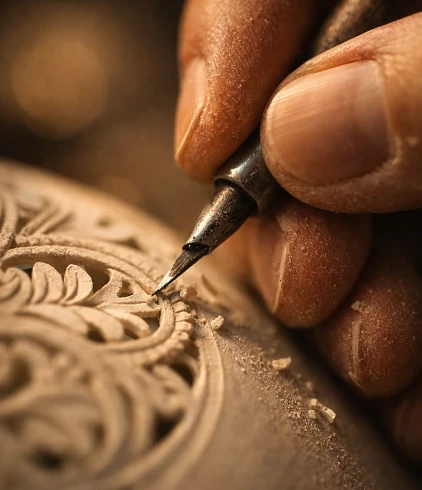
Craft leaves a fingerprint that machine perfection can't fake.
More recently, we began to see more and more premium brands use a more handmade, crafty style. Wonky line writing, imperfect illustration and analogue design techniques. This becomes a powerful way for brands to humanize themselves and accompany their tone of voice. Branding is essentially the humanization of products or services, so the more we can connect with our audience, the stronger the brand is, right?
All being said, we can now perhaps see the perceptions of premium are beginning to change. Minimalism will always have a place in my heart, but will it still be a good direction for premium brands in 2030? Will human craft eventually look bland? Will we see verification certificates put in place for human craft? We often see "handmade", "single origin", "small batch", "hand-finished", "Made in Italy".
Could creative work eventually have an equivalent?
Peace